This article is from a teaching I did at my church earlier
this year.
For the past year, we have been working our way through
the Nicene Creed at church, because as of this year, this
historic orthodox creed has been on the lips of the
faithful for 1,700 years.
If you believe these words, you stand with centuries of
Spirit-filled brothers and sisters who have gone before
us.
We will be looking at the beginning of the last paragraph
of the Nicene Creed, which states:
“And we believe in the Holy Spirit, The Lord, the
giver of life.”
Speaking on the Holy Spirit is always a little
intimidating. After all, He’s generally the least
understood and acknowledged person of the Trinity.
The Father we pray to. The Son we sing about. And
the Holy Spirit?
Well, He’s often treated like the quiet roommate in a
three-bedroom divine apartment. You know He’s there,
things get mysteriously done, but He doesn’t always get
invited to dinner conversations.
It is an unfortunate truth, but one that makes sense given
our physical being and sight, that the Holy Spirit is
sometimes overlooked in our daily worship and practice.
Yet we have before us the third person of the Trinity. We
are discussing God. The Lord. The giver of life Himself.
Why Do Creeds Matter?
You may have heard people say something along the lines
of, “The Trinity is nowhere in the Bible.” Simply put,
that is wrong. While the word “Trinity” is not found in
the pages of Scripture, the teaching and profession of
this doctrine is alive and well, and we see that reflected
here in our portion of the creed.
We believe in one God, and yet, Father, Son, and Spirit
are all identified as God in this ancient creed. Why?
Creeds themselves are not authoritative in the way
Scripture is. They are only true and authoritative if they
align with God’s Word, which uniquely has the ultimate
authority for His people. Creeds provide a necessary
guardrail to our understanding of God and the doctrines of
our faith. They are geared toward a universal
understanding of the faith for all believers.
Even those who do not profess to hold to a creed, when
pressed, would give you some sort of profession of their
faith and understanding of God’s Word. For example, if
someone were to say something like, “I have no creed but
Christ,” you could ask them, “Christ, who is that?” They
would (hopefully) go on to tell you that Jesus is the
Christ, the only Begotten Son of God, who was born of a
virgin, and so on. Effectively, they would be giving you
their creed or profession of faith.
We all have an understanding of God and His Word. The
question is, what is it? That is your creed.
In this section of the Nicene Creed, we’ll look at three
points about the Holy Spirit:
Focusing on the Spirit
The Spirit is Lord
The Spirit gives life
1. Focusing on the Spirit
Before our beloved creed was penned in 325 A.D., a few
other creeds were already circulating. The most notable
one was the Apostle’s Creed, written sometime in the
mid-to-late second century.
Creeds and confessions that develop over time generally
come out of the church battling heresies that are creeping
in and corrupting the faith. That was the case with the
Nicene Creed in 325. The main point of concern was
fighting against the heretical view that Jesus is not God,
so other points in the creed were not as heavily
emphasized.
In God’s providence, these heresies that pop up over time
in the New Testament church force us into His Word to
really examine the faith. It is through centuries of using
people’s lives for studying and learning the Scriptures,
and even giving their very lives to keep and steward them,
that we exist today.
The reason we have these words and terms like Trinity,
Deity of Christ, and others to describe theological
concepts is that God used someone before us, and probably
some ancient heresy, to define a certain theological
point. We often take for granted the blood, sweat, and
tears that were required to hand down the faith and the
Word of God that defines it today.
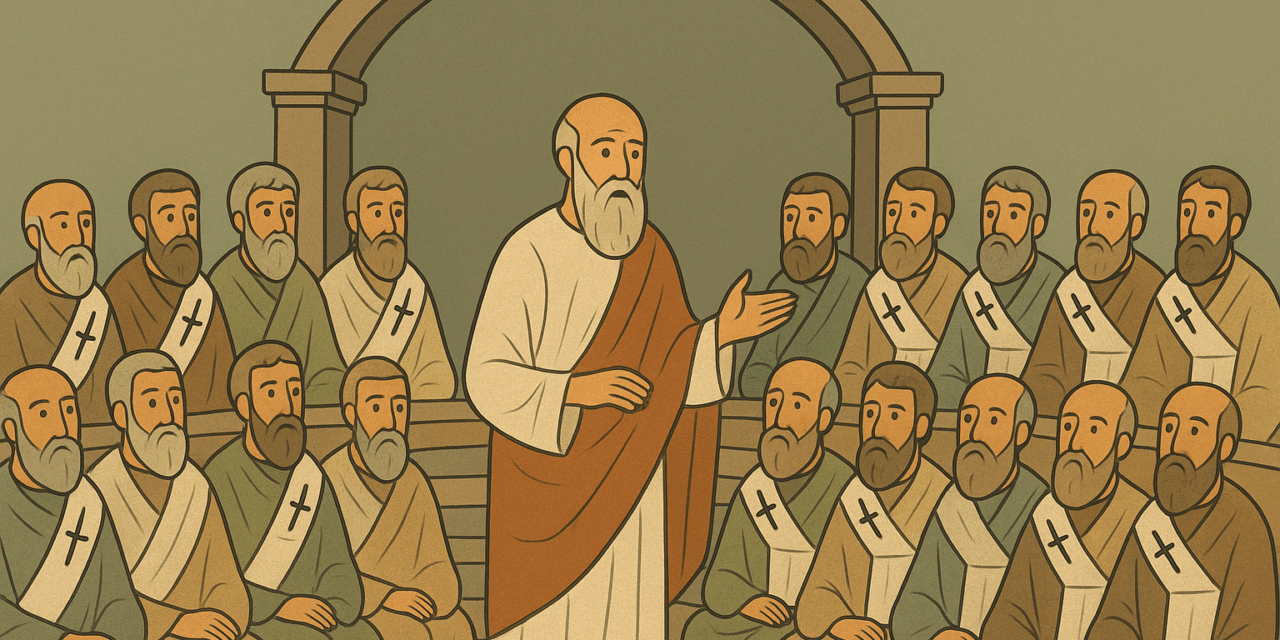
A much less well-known council took place in 381 A.D. in
Constantinople, which is modern-day Istanbul. The issue
floating around at this time was known as
Pneumatomachianism (a $10 word that means “people
who deny the full divinity of the Holy Spirit”).
This is not the Second Council of Nicaea, which met in 787
A.D., which was a heretical political charade used in an
attempt to shoehorn unbiblical man-made traditions into
orthodox Christian doctrine.
The original Nicene Creed was written in 325 and revised
in 381. This is the creed we have today. The 381 council
is not the Second Council of Nicaea, which came centuries
later.
One of the concerns of the church fathers (a reverent term
for the early church leaders who contributed to the creed)
was that there was not enough emphasis on the person of
the Holy Spirit in the creeds thus far.
As mentioned before, given our fleshly eyes that do not
physically see the spiritual realm, the mighty Spirit of
God is sometimes overlooked to our shame. Or, on the flip
side, He is far too over-emphasized, which leads to the
other ditch of hyper-spiritualized practice that goes
beyond the confines of Scripture.
The Nicene Creed in 325 focused on articulating the second
person of the Trinity, Jesus Christ, as being fully
divine. The council in 381 revisited the creed in light of
a new heresy and emphasized the full divinity of the Holy
Spirit.
So, they extended the section about the Holy Spirit,
giving us the verbiage found in the fourth paragraph of
the Nicene Creed today.
These heresies throughout church history are damnable,
meaning if you truly believe them, it puts you outside the
realm of genuine Christian faith and will lead you to
hell. Yet as we see throughout Scripture, the enemy
intends things for evil, but God intends them for good. He
is in total control of all things at all times.
It is because of this heretical view of the Spirit that
there is more emphasis on Him in this portion of the creed
(the 381 revision) than in previous creeds, such as the
original Nicene Creed of 325 or the Apostles’ Creed of the
second century.
The Apostles’ Creed said only,
“We believe in the Holy Spirit.”
That’s it. Why? Because no one was opposing the Deity of
the Spirit of God at that point. It was assumed that the
Spirit of God is God.
Our brothers didn’t get this from their imaginations or a
smoky back room at a council. They got it from the Word of
God, which clearly teaches that the Holy Spirit is Himself
a person who is also the one true God.
Triune, this is our God. Three persons, one being.
Do you find that hard to picture? I do. There is nothing
like Him in all of creation. He is holy, which means He is
set apart and separate from all other things.
As the Lord says to Isaiah in chapter 40, verse 25:
“fTo whom then will you compare Me,
that I should be like him? says the Holy One.”
So, if you find it hard to fully understand the Trinity,
do not feel bad. God has designed it that way. He can be
understood truly, but not exhaustively. There is nothing
in all creation to compare Him to.
We now have the context for our next two points. The
portion of the creed we are examining was revised in 381
not because the original writers didn’t believe it, but
because everyone did.
2. The Spirit Is Lord
It was not just the opinion of the writers of this creed;
they looked at God’s Word and said, “The Holy Spirit is
God, and that is a necessary part of the faith.”
This is what makes the creed true. It is not true because
the writers were smart or had new ideas, but because this
is what God’s Word says.
The Nicene Creed was originally written in Greek, and the
word used for “Lord” is Kyrios. This was
intentional and significant.
The Bible was not originally written in English. Jesus was
not a first-century British lad with His trusty KJV in
hand. When Christ and the apostles referenced Scripture,
they used the Greek Septuagint, a Greek
translation of the Hebrew Scriptures.
Greek was the common language in Jesus’s time, while
Hebrew was the language of the Israelites before Christ.
Almost all of the Old Testament was written in Hebrew, and
all of the New Testament in Greek.
The word Kyrios appears many times in the New
Testament and simply means “Lord.” It is not always used
of God, but most often it is.
So, when the writers of the creed used this word to
describe the Holy Spirit, they were declaring that the
Spirit is God. The word Kyrios in Scripture,
depending on context, is often used to identify the Deity
of God Himself.
A clear example is Romans 10:13:
“For t“everyone who calls on the name of the Lord will be saved.”
Paul is quoting Joel 2:32, where “the Lord” refers to
Yahweh, the covenant name of God. In the Greek
Septuagint, the word used to translate Yahweh is
Kyrios.
Paul continues this tradition in Romans, using
Kyrios again in verse 9:
“because, if myou confess with your mouth that Jesus is Lord and nbelieve in your heart othat God raised him from the dead, you will be saved.”
Paul intentionally applies the divine name Yahweh to
Jesus, affirming that to call on Jesus is to call on the
Lord of Joel 2:32.
This is a powerful affirmation of Christ’s full deity.
This use of Kyrios was not accidental. It was the
same word used by the Church in the Nicene Creed—first in
325 to declare Jesus as “The Lord,” and then again in 381
to declare the Holy Spirit as “The Lord, the giver of
life.”
The Church fathers were deliberate in using
Kyrios, a word rich with divine meaning, to
identify both the Son and the Spirit as fully and equally
God.
Another great example of the Holy Spirit being identified
as both a person and as God is in Acts 5:3–4:
“But Peter said, ‘Ananias, why has xSatan filled your heart to lie yto the Holy Spirit and zto keep back for yourself part of the proceeds of the land? 4 While it remained unsold, did it not remain your own? And after it was sold, was it not at your disposal? Why is it that you have contrived this deed in your heart? You have not lied to man but ato God.””
Ananias lied to the Holy Spirit. Have you ever lied to an
impersonal force before? You cannot lie to gravity or
electricity. You lie to people.
So, first, we see the personhood of the Holy Spirit. He
was lied to. Then Luke says, “You have not lied to man but
to God.”
Which is it? Did Ananias lie to the Holy Spirit or to God?
Yes. Both. Because the Holy Spirit is God.
This is why the creed needed to call the Spirit “The
Lord”, applying the Divine Name to the person of the
Holy Spirit.
We are talking about who God is. If you reject who God is,
you have rejected God. That is not a minor issue—it is a
matter of salvation.
If you believe in a false god, you are an idolater and
will not be saved. There is one God who can save you from
your sins, and He has revealed Himself in the pages of
Scripture.
So, praise God for the Nicene Creed, for its revision in
381, and yes, even for the heresy that made it necessary.
All of these things have been used providentially
throughout history for our good and God’s glory.
3. The Spirit Gives Life
There are two layers to this statement. The Spirit gives
physical life, and He gives spiritual life.
The Spirit Gives Physical Life
In Job 33:4, Job says:
“kThe Spirit of God has made me,
and lthe breath of the Almighty gives me life.”
This echoes Genesis 2:7, where God formed Adam from the
dust and breathed life into him. Job makes it clear: that
breath of life was the Spirit of God.
Romans 8:11 says:
“If the Spirit of Him who raised Jesus from the dead dwells in you, He who raised Christ Jesus4 from the dead will also give life to your mortal bodies bthrough His Spirit who dwells in you.”
Not only did He breathe life into you in creation, He will
do it again at the resurrection. It is as sure as Christ
Jesus, the firstborn of the dead, rising from the grave!
Death has no power over our God.
The Spirit Gives Spiritual Life
Let’s go meet the Lord Jesus Christ in Jerusalem.
It’s a cool eastern night. Under the cloak of
darkness, He’s talking to a certain Pharisee named
Nicodemus in John chapter 3.
Jesus tells him that unless one is born again, he cannot
see the Kingdom of God. Nicodemus responds, paraphrasing,
“You expect me to fit back inside my mother’s womb!?”
Oh, Nicky, my boy. Do you think Jesus chuckled at that
one? Did I not start this post off by saying that we are
so focused on the physical we sometimes neglect the unseen
things of the spiritual world?
Jesus replies to him in verses 5-6,
“Jesus answered, “Truly, truly, I say to you, unless one is born qof water and the Spirit, he cannot enter the kingdom of God. 6 rThat which is born of the flesh is sflesh, and that which is born of the Spirit is spirit.3.”
Notice that one “Spirit” is capitalized. Jesus is talking
about the miracle of regeneration—the new birth brought
about by the Spirit of God.
This is what it means to be born again. To be raised from
spiritual death to spiritual life by the power of the Holy
Spirit, just as our creed says.
The Spirit of God truly is the Giver of life, both
spiritual life and physical life.
Conclusion
My friends, this is not some theory created by radicals or
a plot by political leaders to control the narrative. The
Nicene Creed confesses these things because they are the
clear testimony of God’s Word.
We can personally know the Spirit of God because of what
Jesus Christ has done on the cross, bridging the chasm
between man and God that was caused by our sin.
It is this Holy Spirit who breathed out the words of
Scripture (2 Timothy 3:16), who validates our creed, and
who gives life.
And that is why:
“We believe in the Holy Spirit, The Lord, The
giver of life.”